July 06, 2026
Cancelled National Standards Are Back in Force: What Order No. 147 of SE “UkrNDNC” Means
On June 24, 2026, SE “Ukrainian Research and Training Center for Standardization, Certification and Quality” issued Order No. 147 “On the Restoration of National Standards.”
At first glance, this news may seem unexpected, as in recent years Ukraine has been consistently moving away from outdated regulatory documents toward harmonized European standards. However, a closer look shows that this decision is not a rejection of the European course, but rather a pragmatic step aimed at ensuring the stable implementation of public infrastructure projects during the transition period.
The order of SE “UkrNDNC” should be viewed not as a return to the old standardization system, but as a temporary mechanism. It allows public customers, manufacturers of construction materials, contractors and testing laboratories to continue operating without regulatory gaps until the transition to a fully harmonized system of standards is completed.
How the changes in the regulatory framework developed
To correctly understand Order No. 147, it is important to consider it not as a separate decision, but as one of the stages in reforming the national standardization system.
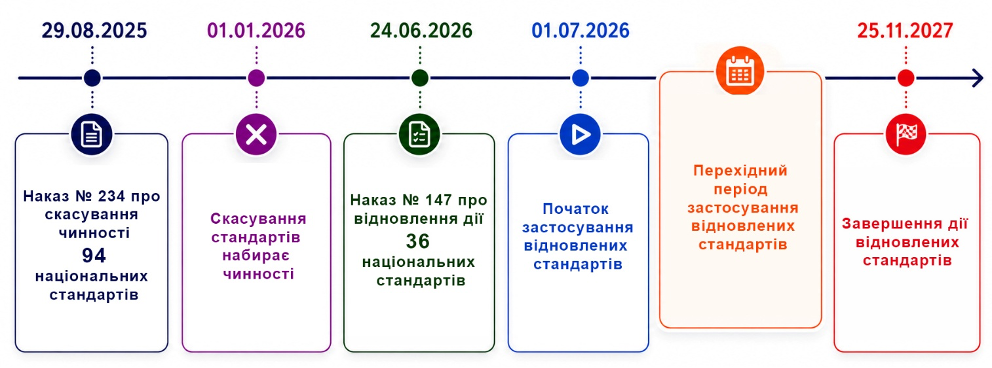
On August 29, 2025, SE “UkrNDNC” issued Order No. 234, which determined the termination of a significant number of national standards from January 1, 2026. The main purpose of this decision was to accelerate Ukraine’s transition to a modern regulatory framework harmonized with European standards.
However, practical experience in implementing public infrastructure projects showed that certain areas of the construction sector still require the use of national regulatory documents. That is why Order No. 147 was adopted, temporarily restoring the validity of some standards under clearly defined conditions of application.
What exactly Order No. 147 changed
The order restored the validity of 36 national standards, but their application has clearly defined limits.
First, they may be used only for the production and/or supply of products under orders from public customers.
Second, their validity is temporary — until November 25, 2027.
These restrictions are essential for properly understanding the content of the regulatory documents and the specifics of their practical application.
The restored standards cover a wide range of areas in the construction sector, including:
| Area | Основний зміст |
| Soils | Classification, sampling, laboratory and field testing, methods for processing results |
| Aggregates | Sand, crushed stone, gravel and mixtures, testing methods |
| Concrete mixes | Technical specifications and testing methods |
| Concrete | Methods for determining frost resistance |
| Chemical admixtures | Methods for assessing effectiveness |
| Structures | Protection of concrete structures, reinforcement control |
| Waterproofing materials | Roofing mastics, roll materials, sealing products and testing methods |
| Transport infrastructure | Bridges, tunnels, metro systems, road elements |
Why the decision to restore the standards was made
The reasons behind Order No. 147 are much deeper than they may seem at first glance.
The restoration of certain standards was not the result of a revision of state policy in the field of standardization. On the contrary, it was a response to practical challenges that arose during the implementation of large-scale infrastructure recovery programs.
After the termination of a significant number of national standards from January 1, 2026, certain public customers, design organizations, manufacturers of construction materials and testing laboratories faced a situation in which, for a number of technological processes, there was no full regulatory alternative or sufficient practical experience in applying the new harmonized standards had not yet been accumulated.
That is why, following consultations between relevant ministries, the State Agency for Restoration and Infrastructure Development of Ukraine, technical standardization committees and industry experts, a decision was made to temporarily restore the validity of certain national standards.
What this means for market participants
The restoration of certain national standards has different practical implications for construction market participants. For some, this decision provides the necessary regulatory certainty when fulfilling public contracts. For others, it ensures the ability to continue using established quality testing methods.
| Market participant | Practical significance of Order No. 147 |
| Cement manufacturers | Regulatory certainty is ensured when supplying products for public infrastructure projects where technical documentation refers to the restored standards. At the same time, the need remains for further implementation of harmonized international and regional standards. |
| Manufacturers of concrete mixes and products | The possibility of applying certain technical specifications and testing methods when fulfilling public orders is restored. This minimizes the risks of regulatory conflicts and simplifies compliance with customer requirements. |
Aggregate manufacturers
| The application of certain standards for natural and technogenic aggregates, as well as their testing methods, is temporarily restored. This is particularly relevant for companies whose products are intended for use in the construction and restoration of infrastructure facilities. |
Testing laboratories
| Laboratories are able to officially perform tests according to the restored methodologies in cases provided for by public contracts. At the same time, current replacements for cancelled standards must be taken into account in accordance with the applicable regulatory framework. |
Design and contracting organizations
| The risk of regulatory gaps during design, expert review, construction and acceptance of completed works is reduced. This contributes to more stable implementation of public infrastructure projects during the transition period. |
| Public customers | Conditions are created for the uninterrupted implementation of construction, reconstruction and infrastructure restoration programs without the need to revise a significant amount of technical documentation and material requirements. |
Conclusion
Order No. 147 of SE “UkrNDNC” is an example of a pragmatic approach to the development of Ukraine’s regulatory framework. It makes it possible to ensure the stable implementation of public infrastructure projects without abandoning Ukraine’s strategic course toward harmonizing the national regulatory framework with regional and international standards.
Therefore, the restoration of certain national standards should be viewed as a temporary regulatory solution, not as a return to the previous system of technical regulation.
For manufacturers of construction materials, testing laboratories, design and contracting organizations, this decision provides the necessary regulatory certainty, minimizes legal and technical risks, and creates predictable conditions for fulfilling public contracts.
At the same time, the established transition period should be used to complete the adaptation of production, factory production control systems, testing laboratory activities and technical documentation to the requirements of harmonized standards. In the future, these standards should become the basis of regulatory support for Ukraine’s construction sector.